
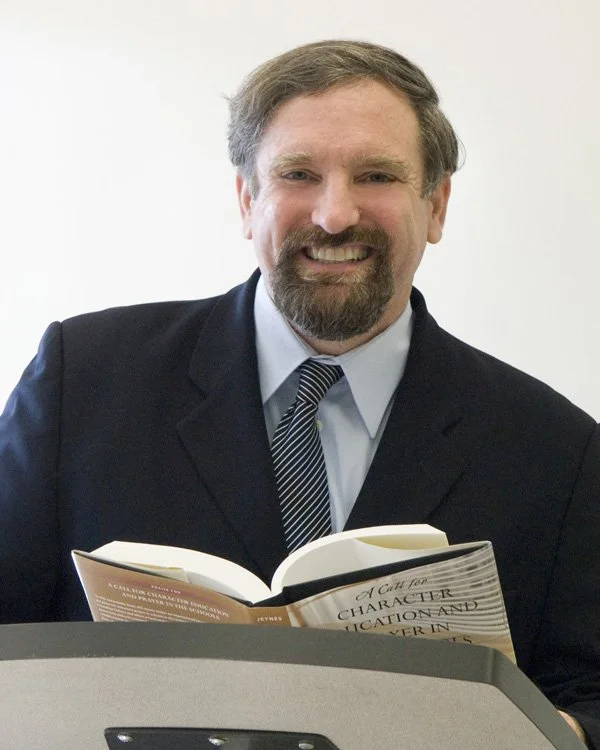
OXFORD, England — A Harvard graduate spoke at Oxford University on the need to encourage marriage, intact families, and the best parental style in order to help students thrive. Dr. William Jeynes, a graduate of Harvard and Chicago, and a professor at California State University in Long Beach, used a variety of meta-analyses that he had recently undertaken to analyze the effects of parental divorce on children, as well as the impact of parental style that emphasizes love and structure in a child’s day on student scholastic outcomes. Seventy-eight studies from all over the world were included in the meta-analysis.
A meta-analysis is a quantitative approach to statistically summarize the body of research on a given topic. It is therefore extremely practical and useful for educators, academics, government leaders, parents, and students who do not have the time to read all the individual studies on the topic. A meta-analysis statistically combines all the relevant existing studies on a given subject, in order to determine the aggregated results of said research. A meta-analysis is among the most popular type of academic articles, as measured by citations, because it enables people to grasp what the overall body of research on a given topic indicates.
Professor Jeynes has been doing meta-analyses since the mid-1990s on a variety of topics in order to improve academic outcomes. He has spoken on his results for the White House, the U.S. Department of Education, the U.S. Department of Justice, The U.S. Department of Health and Human Services, the E.U. and several G20 governments.When asked how these recent meta-analyses differ from his past ones, Dr. Jeynes answered that people are craving for love in the world, wise guidance, and stability. He added, “I think the results of these meta-analyses support that notion. Many from the Gen Z population were raised in homes in which there was a single-parent with little or no access to the second parent. Others were raised in homes with a dearth of love or structure. Children want to be loved, in part, because they need to be loved. This world is often a hard place in which to live. As the old Peter and Gordon song declares, “I don’t care what they say, I won’t live in a world without love.” In contrast, the Bible declares what many young adults and older teens long for: “God is love” and “Faith, hope, and love abide these three, but the greatest of these is love.” A lot of people from this younger generation view the current world as lost, cold, and obsessed with technology rather than on loving and caring for people. Perhaps it should not surprise us that now that the Bible as Literature one-to-two year classes have been passed in so many states and cities; and public school students are studying the Bible in great numbers, those of the Gen Z population see an attractive alternative. A revival came to Asbury University, major secular and Christian universities through the Mid-West, Southeast, South Central States, and even out to California. The data are clear: love works and upbuilds, strong families encourage children to feel secure, and involved parents send a message of love and caring. The meta-analytic data support the perspectives of the Gen Zs. Will it be enough to cause real spiritual renewal? Time will tell. If you’re interested,” Jeynes declared, “a new book entitled, ‘Young Adults Return to Faith and the Invisible (Cambridge Scholars Publishing)’ statistically and historically examines the possibility.”
###
Contact:
William Jeynes
714 397-7763
whjharvard@post.harvard.edu
Disclaimer: The views and opinions expressed in this article are those of the authors and do not necessarily reflect the official policy or position of Religion News Association
