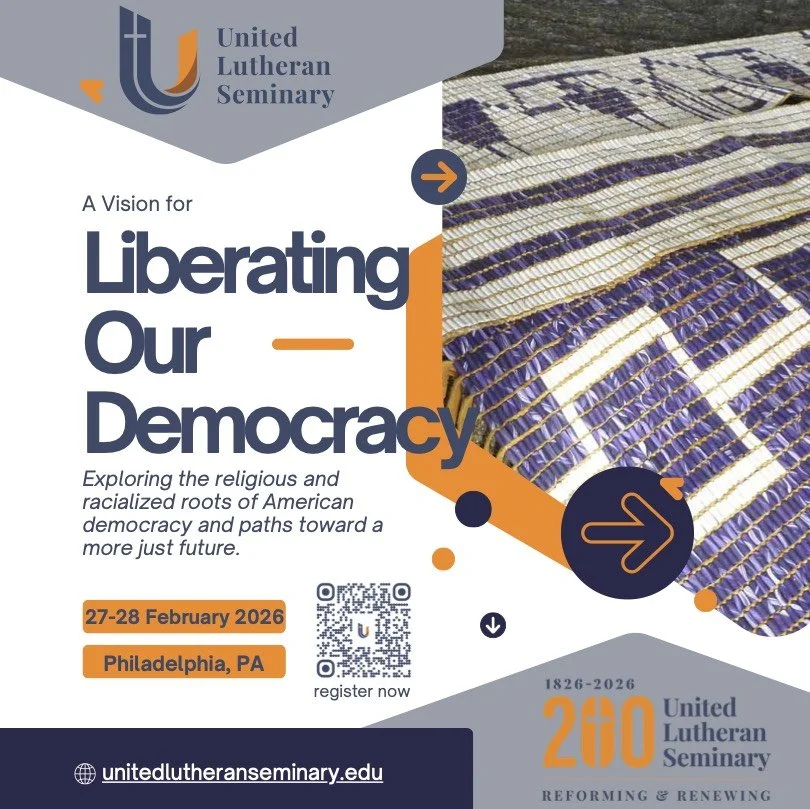
Two-day gathering will explore the religious and racialized roots of American democracy and paths toward a more just future.
United Lutheran Seminary (ULS) will host A Vision for Liberating Our Democracy: Examining the Religious and Racialized Roots of American Democracy on February 27–28, 2026, at its Philadelphia campus. The interdisciplinary conference will bring together scholars, activists, educators, and faith leaders to examine how religion and race have shaped democratic life in the United States and to explore liberative visions for the future.
The conference builds on a growing body of research that examines the theological, cultural, and political intersections of democracy, citizenship, and power. Participants will investigate how worldviews and faith traditions have informed concepts of governance, belonging, and personhood from the founding era to the present. The conference will highlight not only the Haudenosaunee Influence on American Democracy but also the historic and present contributions to Democratic thought by Black, Indigenous, and Latine communities, contributions which are often forgotten and ignored.
“As America’s oldest Lutheran seminary, founded by an antislavery theologian 200 years ago in Gettysburg on land that was to become part of the Civil War’s greatest battlefield, United Lutheran Seminary has always been part of the nation’s conversation on race and freedom,” said the Rev. Dr. R. Guy Erwin (Osage Nation), ULS president. “The Lutheran heritage of freedom of conscience and its emphasis on serving the common good draw us always from faith toward action. With this conference, our Seminary returns to the center of our current national debates.”
Dean Teresa L. Smallwood said, “The American context is ripe for a time of reflection on the concept of democracy. “We the People” must evaluate our democratic commitments as we witness our nation entering a period of structural erosion. It is felt across all pockets of the nation. Have we redefined the governance schemata such that democracy is literally on life support? Do we continue to believe in the checks and balances of government? Is America a bastion for equality or have we reordered our commitments as a nation? These are some of the questions we must wrestle with at this conference.”
“United Lutheran Seminary is committed to fostering public conversations about the moral and historical foundations of democracy,” said the conference organizing committee member Adam DJ Brett. “By examining the ways religion and race intertwine with political life, we can better imagine inclusive and equitable systems of governance.”
Featured Speakers
The conference will feature exciting plenary addresses by
Maya D. Wiley, President and CEO of Leadership Conference on Civil and Human Rights
Alba Onofrio (Reverend Sex), Executive Director of Soulforce
Raymond Winbush, Research Professor and the Director of the Institute for Urban Research, Morgan State University
Dr. Joseph Evans, The J. Alfred Smith, Senior Professor of Theology in the Public Square Director at Berkeley School of Theology
Brandon Paradise, Associate Professor of Law and Professor Dallas Willard Scholar at Rutgers Law School
Dr. Gabby Cudjoe Wilkes, Pastor of The Double Love Experience Church
Tadodaho Sidney Hill of the Haudenosaunee Confederacy
Betty Hill (Lyons), (Onondaga Nation, Snipe Clan), Executive Director of the American Indian Law Alliance
Dr. Benjamin F. Chavis, Jr., President and CEO of the National Newspaper Publishers Association (NNPA): The Black Press of America.
Naomi Washington-Leapheart, Strategic Partnerships Director, Political Research Associates
Dr. Yvette R. Blair-Lavallais, Equity Research Fellow for Feeding America and Professor at Memphis Theological Seminary
Rev .Dr. Obery M. Hendricks, Jr., Visiting Scholar, Departments of Religion & African and African Diaspora Studies at Columbia University
Damien C. Durr, General Secretary of the Proctor Conference
Call for Papers – The organizing committee invites papers on the following Topics to Be Covered During Exploring Religion, Race, and Democracy:
The Middle Passage, The Mid-Atlantic Slave Trade, Maa’afa
The Continental Congress and the Balance of Power
The Haudenosaunee Influence on American Democracy
E.B. Du Bois and the Black Reconstruction of Democracy
The Doctrine of Discovery and settler colonial foundations
White Christian nationalism and the myth of civil religion
Religion, race, and legal personhood
Religion and resistance in Black, Indigenous, Latine, and immigrant communities
Race, religion, and the media in shaping democratic narratives
Womanist, Feminist, and Mujerista Methodologies
Foreign Policy and Human Crises
Submission Information
The organizing committee invites proposals for papers, panel discussions, roundtables, and creative presentations. Submissions from scholars at all career stages, including graduate students and early-career researchers, are encouraged. We are open to presentations from independent scholars as well.
The program will also include undergraduate poster sessions, graduate student panels, and live podcast recordings designed for classroom and public scholarship use. Following the event, an open-access journal volume will publish selected presentations.
Proposals should include a 300-word abstract and a 100-wordbiography. The submission deadline is January 15, 2025. Proposals may be sent to abrett@uls.edu.
Event Details
Conference: A Vision for Liberating Our Democracy :Examining the Religious and Racialized Roots of American Democracy
Dates: February 27–28, 2026
Location: United Lutheran Seminary, 7301 Germantown Avenue, Philadelphia, PA 19119
Submission Deadline: December 15, 2025
Contact: Adam DJ Brett, abrett@uls.edu
Disclaimer: The views and opinions expressed in this article are those of the authors and do not necessarily reflect the official policy or position of Religion News Association
